

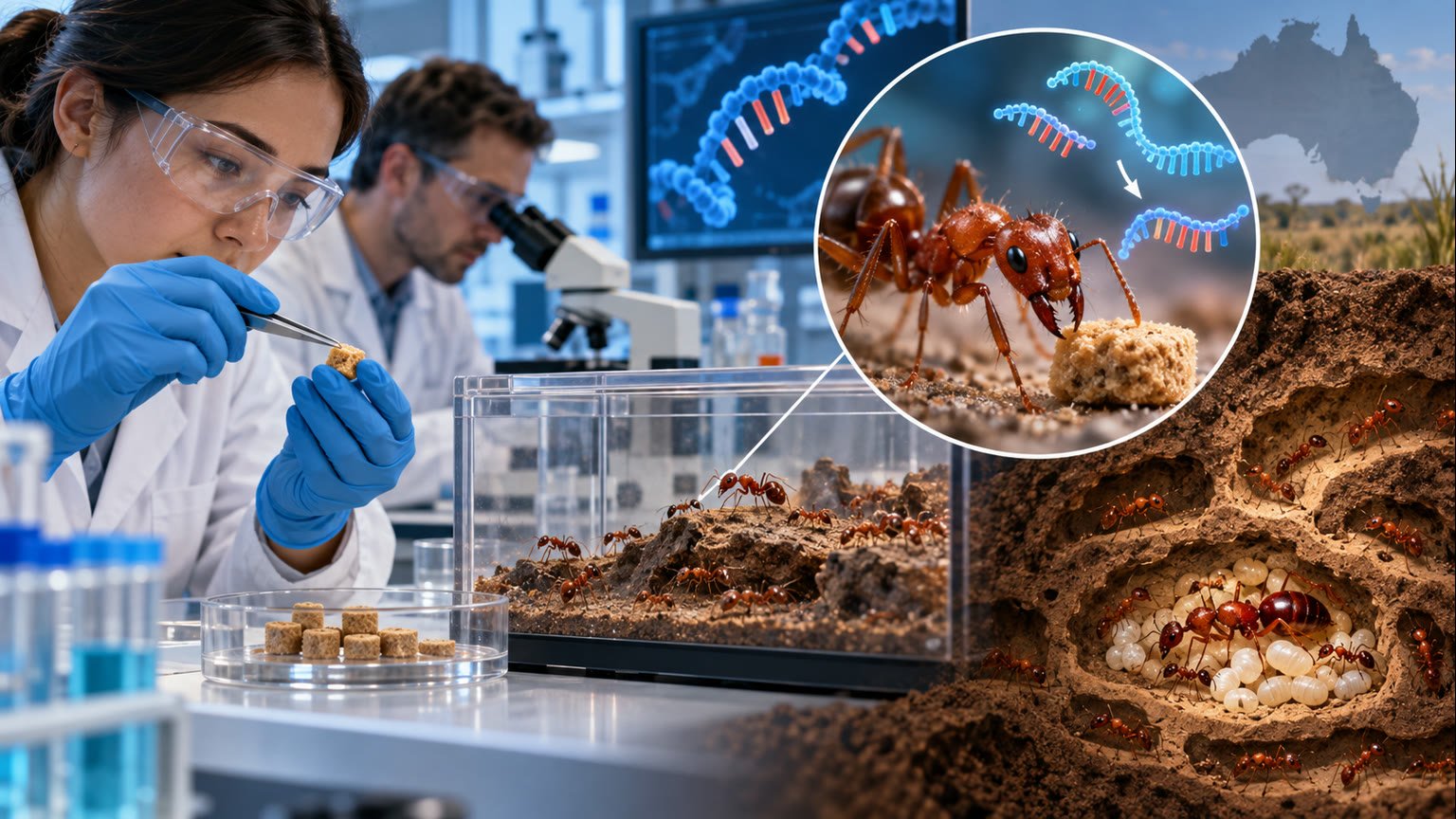
The laboratory work uses RNA interference, or RNAi, to interrupt genetic messages that fire ants need for functions such as reproduction, communication, feeding and digestion. Researchers are selecting gene fragments unique to fire ants to reduce the risk of affecting other species.
A central challenge is delivering the RNA molecule through a bait that survives environmental exposure, remains stable inside an ant and can be carried back through the colony. CSIRO is testing a patented molecule intended to improve stability and effectiveness.
Early laboratory trials have improved over successive tests, but CSIRO says more research is required before the approach can move outside the laboratory. The work is being supported by CSIRO, the National Fire Ant Eradication Program and the US Department of Defence through the University of Berkeley.
Illustration disclosure: The featured image is an AI-generated editorial illustration. It does not depict the named researchers, an actual CSIRO laboratory or an approved commercial treatment.