
US President Donald Trump says he wants a "permanent" agreement with Iran that would stop it obtaining a nuclear weapon, while signalling that a decision on his next move in the war could wait until after the new year.
In a phone interview with Fox News on Saturday, 21 November, Trump said: "What I'm doing is I'm going to make it so that if we have an incompetent president in four years or 15 years or 20 years, I'm going to make a deal that is going to be permanent." He added: "I'm not going to let somebody allow them to have a nuclear weapon."
The president said Iranian officials had been "very, very difficult" to negotiate with. "I mean, we make a deal and then they break the deal the next day," he said.
Two days earlier, Trump told Israel's Channel 12 that he was in no hurry. "I'm not rushing to make any decisions on Iran," he said. "We'll see what happens after the new year starts." CBS News reported that the remark suggested his next move might not come until 2027.
The comments came as Iran's foreign minister, Abbas Araghchi, said diplomacy must be given a chance and linked the reopening of the Strait of Hormuz to the United States meeting Iranian conditions.
"The ongoing talks in the region must be given a chance, and the blockade must be lifted rationally," Araghchi said, according to Iranian state television. "Our position is clear: as long as Iran's demands are not met, the discussion on the Strait of Hormuz and its opening is pointless."
Iran's conditions have included ending the war on all fronts, unfreezing Iranian assets, lifting oil sanctions and ending the US counter-blockade of Iranian ports. Araghchi also said reopening the strait was "not difficult" if Washington accepted "reasonable conditions that are in accordance with international law", Tasnim reported.
A Qatari delegation visited Tehran on Friday night and held two hours of talks with Iranian officials, Deputy Foreign Minister Kazem Gharibabadi said, according to the semi-official Tasnim news agency. Gharibabadi said contacts with mediators were continuing but the talks had not yet become formal negotiations. He said Iran's enriched uranium must not leave the country and described the US economic blockade as an act of war.
The diplomatic signals came amid fresh violence in the Gulf. Britain's UK Maritime Trade Operations said two tankers were hit in the Strait of Hormuz on Saturday, one struck on the stern by an unknown projectile and another in its engine room, with no casualties reported. Iran said it shot down a US drone over Qeshm Island, according to Iranian state television.
Bahrain's interior ministry said an Iranian attack hit a civilian industrial facility on Saturday, causing a fire and material damage but no injuries. It was the fourth attempted attack in Bahrain in about a week. The United Arab Emirates condemned the strike on Sunday as a "flagrant violation" of Bahrain's sovereignty. A US official told CBS News there were no impacts on US forces or military assets.
Iranian state television also showed a new dual-missile launcher at an underground facility, and the commander of the Islamic Revolutionary Guard Corps toured the site, Al Jazeera reported.
The war began when the United States and Israel attacked Iran on 28 February 2026, prompting Tehran to strike Israel and Gulf states hosting US bases. Former Supreme Leader Ali Khamenei was killed in the initial strikes; his son Mojtaba Khamenei has held the title since, CBS News reported.
Before the conflict, about one fifth of the world's oil and natural gas passed through the Strait of Hormuz. Iran has restricted shipping through the waterway, and the US has imposed a naval blockade on Iranian ports in response.
CBS News reported last week, citing sources familiar with the matter, that the US and Israel were considering a new assault on Iran over concerns about how quickly Tehran was rebuilding its weapons production capacity. Trump has separately said new strikes were "quite unlikely".
Sources: CBS News live updates, 21-22 November 2026; Al Jazeera, 21 November 2026.
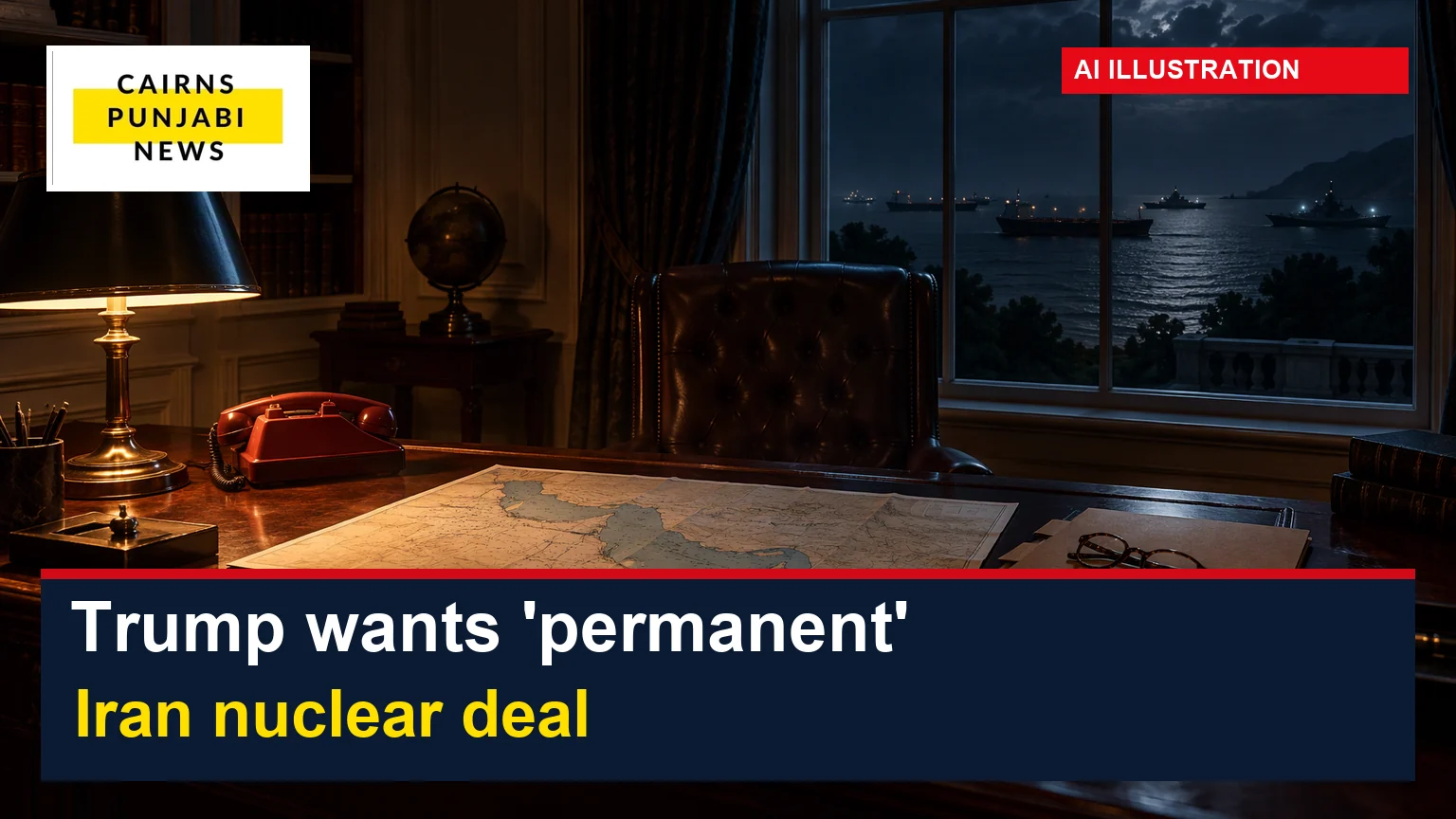
Image: AI-generated editorial illustration, created with ChatGPT, of an empty desk with a red telephone and a map of the Strait of Hormuz, with tankers offshore. It is not a photograph and does not depict a real meeting or scene.